A distinguished abstract painter, Dorothea Rockburne’s public profile is surprisingly modest in relation to her achievement. The names of her painting instructors at Black Mountain College in the 1950s—Franz Kline, Philip Guston and Jack Tworkov—are more widely recognized among the general public than her own. Nevertheless, her worldwide exhibition record is as enviable as her many prestigious fresco commissions. “Astronomy Drawings,” now on the final leg of a national tour that began one year ago at Wheaton College, is a testament to a long and laudable career.
Rockburne is that rare thing: a painter who has seized upon a germinal idea that, in itself, is inexhaustible. Her imagery derives from themes that roam through physics, astronomy and the applied mathematics that underwrote Quattrocento Florentine design (e. g. the golden section). The expansiveness of her tapestry of themes has freed her from falling into the common trap of becoming an imitator of one’s own art.
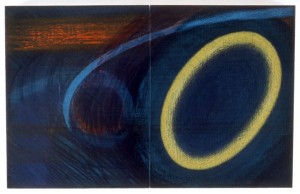
The dynamism of her imagery and surface loveliness—in short, the art—is what matters, not its claim on more rigorous intellectual disciplines. Among the most seductive pieces here are two modestly scaled watercolors, “Summer’s Nighttime Sky” (1993) and “Piero’s Sky,” (1991). Both take advantage of the subtle, granular transparencies that occur when pastel is run deftly over an under layer of watercolor. The first is particularly elegant. A luminous ellipse, like the ring of a sunspot, floats away from traces of a darkened sphere suggesting the occulation of a star. A hint of red breaks through the eclipse, offering a glimpse of something molten in space.
Dominating the gallery are two 60-inch watercolors worked on Duralar, a substitute for acetate that permits water media to flow without feathering. Color does not sink in as it would on paper. Rather, it skims the surface, creating an illusion of suspended radiance. “Three Point Manifold” (2008), with its melting spheres of violet and red spilling over each other, conjures an impressive image of celestial momentum. Her means are perfectly adapted to eliciting a sense of speed and evanescence.
Rockburne’s work is often greeted for the wrong reasons. Overmuch is made of references to science and math. Rockburne is not a mathematician, an astronomer, or an adept at any of the hard disciplines that nourish her imagery. She is a painter who seeks pictorial possibilities in fields that can be mined for forms. Some are schematic imaginings, some indebted to NASA’s telescopic photography and other aerial imagery. Think of Abstract Expressionism doing the Hayden Planetarium.
The most trenchant comment on Rockburne comes from David Cohen, critic and curator of the Studio School’s gallery: “It is not that she embodies, evokes, or depicts extraterrestrial events, say, or numerical sequences or sets so much as she seeks visual equivalences for the systems used to describe and analyze them.” In short, it is the aura of science, not science itself, that is so gratifyingly summoned by these astronomical confections.
©2010 Maureen Mullarkey
This commentary appeared first in CityArts, April 20, 2010.

